My Journey Through the Forgotten Realms: Finding Games That Rival Baldur's Gate 3's Magic
Explore the best games like Baldur's Gate 3 with this captivating guide to top RPG alternatives, featuring deep storytelling and immersive worlds.
As a professional gamer, my life is often measured in frames-per-second, critical hits, and the quiet satisfaction of a perfectly executed quest chain. In 2026, years after its monumental release, Baldur's Gate 3 still casts a long, impressive shadow over the RPG landscape. Its world, a vibrant tapestry woven from the threads of Dungeons & Dragons lore, felt less like a game and more like a portal I could step through. The mind-boggling player choice, the fully-voiced companions who felt as real as my own friends, the rich story that bent and flexed with my whims—it was an experience as rare and precious as a flawless diamond. But after hundreds of hours, after romancing Astarion, mastering the Illithid skill tree, and finally defeating the Netherbrain, a familiar itch returned. I began a new quest: to find other worlds that could capture even a fraction of that same magic.
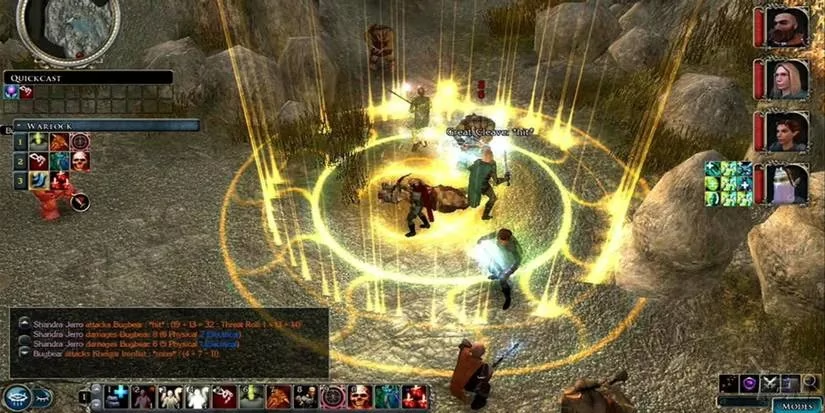
My search was not for mere copies, but for experiences that shared the same soul—deep role-playing, meaningful choices, and worlds that felt alive. I discovered that while Larian's masterpiece stands alone, it is part of a noble lineage. The first gem I unearthed was Neverwinter Nights 2. Returning to it in 2026 felt like opening a beloved, slightly musty spellbook. It's set in the same Forgotten Realms, using the D&D 3.5 ruleset, a system as intricate and interlocking as a dwarven clockwork puzzle. The graphics show their age, a faded mural compared to Baldur's Gate 3's vibrant canvas, but the foundational role-play is there. Exploring Neverwinter was like visiting the ancestral home of Baldur's Gate itself.
Then, I ventured into Tyranny. What a glorious twist! Here, I wasn't the destined hero; I was the bureaucrat of the apocalypse, a functionary of evil. Obsidian's genius lies in making tyranny a system to be managed, its story morphing under my decisions like clay under a sculptor's hands. It was Baldur's Gate's isometric view but through a dark mirror, proving that great RPGs aren't just about saving the world—sometimes, they're about efficiently running it. The narrative reactivity in Tyranny is a silent, powerful engine, as subtle and far-reaching as the Underdark's myconid network.
For the sheer tactical brilliance and party-based camaraderie, I found a surprising masterpiece in a frozen wasteland: Wasteland 3. Don't let the post-apocalyptic Colorado setting fool you. The political intrigue, the weight of every dialogue choice, and the razor-sharp turn-based combat made it a spiritual sibling. Managing my squad of Desert Rangers felt as crucial as balancing my Baldur's Gate party's spell slots and approval ratings. Its focus is less on high fantasy and more on survivalist drama, but the core loop of exploration, tough choices, and strategic combat hit the same sweet spot.
Of course, I had to pay homage to the ancestors. Planescape: Torment, especially its Enhanced Edition, is the philosophical godfather to Baldur's Gate 3's Dark Urge. Waking up as The Nameless One, an immortal amnesiac in the surreal city of Sigil, is an exercise in existential role-play. The question isn't "what can I do?" but "what am I?" Its writing is a dense, poetic tome, and its influence on modern narrative-driven RPGs is as clear as a wizard's scrying pool. Playing it felt like tracing the lineage of my favorite class features back to their source in a dusty, forgotten library.
| Game | Key Similarity to BG3 | Unique Flavor |
|---|---|---|
| Neverwinter Nights 2 | Classic D&D Ruleset, Forgotten Realms | Epic party-based adventuring |
| Tyranny | Branching, reactive narrative | Play as the villain's enforcer |
| Wasteland 3 | Deep tactical combat & party management | Post-apocalyptic political thriller |
| Planescape: Torment | Philosophical storytelling & identity crisis | Surreal, narrative-focused experience |
For those who fell in love with the process of Dungeons & Dragons—the gathering of friends, the rule of a DM—Talespire offered something unique. It's a digital tabletop, a voxel-based playground where the only limit is your group's imagination. While it lacks BG3's authored story, it provides the tools to create your own. Building dungeons and watching friends navigate them with their custom miniatures recaptured the feeling of a real-life session, complete with the chaotic joy of unexpected critical failures.
Finally, I revisited the series that once defined the genre for me: Dragon Age. Origins, with its origins stories and gritty tone, remains a masterclass in making the player feel woven into the world's fabric. Its companion banter around the campfire is the direct precursor to the heartfelt conversations aboard the Baldur's Gate 3 nautiloid. Inquisition, meanwhile, offered the scale and spectacle, a world begging to be explored. These games reminded me that the heart of the RPG isn't just rules or graphics, but the stories we build with the characters we meet along the way.
My journey taught me that Baldur's Gate 3 is not a lonely peak, but the tallest mountain in a vast and rewarding range. Each of these games is a different path up the same slopes of imagination, strategy, and storytelling. Some offer the familiar comfort of dice rolls and armor classes, while others present radically different worlds governed by their own brutal logic. Yet, they all share that essential spark: the power to make you feel like the author of your own epic. In 2026, that magic is alive and well, waiting in libraries digital and ancient, for the next player to open the book and begin their tale.