My Nervous Gamble with Baldur's Gate 3: A Quest of Commitment and Fear
Baldur's Gate 3's CRPG depth and character creation offer an exhilarating, yet daunting, epic journey into choice-laden fantasy. This Dungeons & Dragons masterpiece promises a thrilling adventure, but its overwhelming complexity and legacy from Divinity: Original Sin 2 spark sheer panic alongside anticipation.
As a professional player, the release of Baldur's Gate 3 has me feeling a thrilling cocktail of anticipation and sheer, unadulterated panic. It's finally here, and even though I haven't had a chance to preload the digital behemoth, I've already cleared my calendar, metaphorically chaining myself to my gaming rig for the foreseeable future. Sandwiched between the epic adventures of Tears of the Kingdom and the cosmic promise of Starfield, this Dungeons & Dragons colossus has been my most anticipated game for what feels like an eternity. I've been eyeing it since its early access days, biding my time with a patience I rarely possess, waiting for the polished 1.0 version to emerge. Every glowing review and ecstatic player story I've heard, coupled with my own brief 50-minute foray, screams that this game is something special. After a three-year hiatus from deep CRPGs since my time with Wasteland 3, my spirit is ready for a massive, choice-laden, systems-dense epic. Yet, my hands are trembling on the mouse. The specter of Larian's last masterpiece, Divinity: Original Sin II, looms large over my excitement, casting a long shadow of daunting difficulty and complex beginnings.
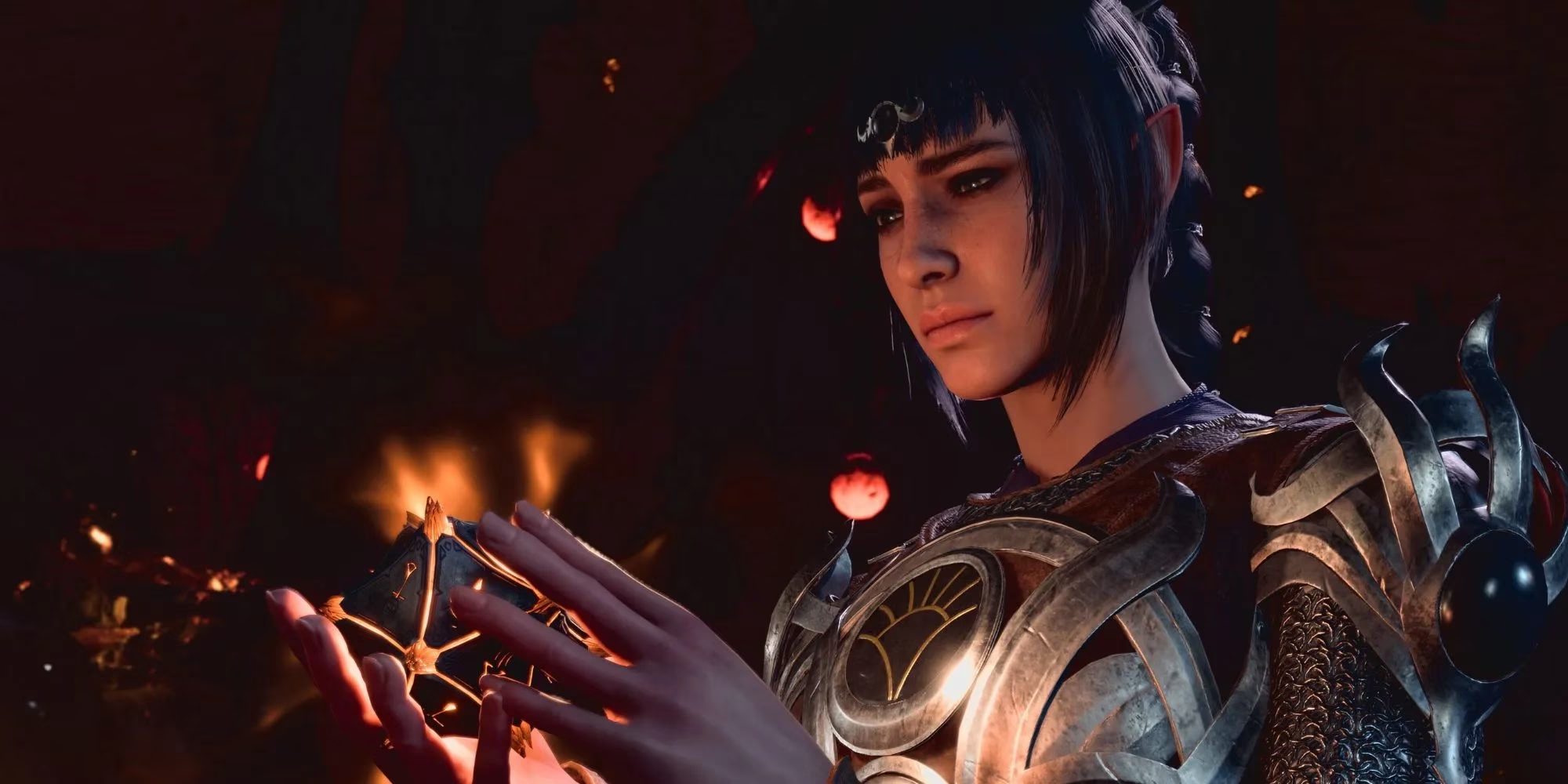
The Paralysis of Infinite Choice: A Creator's Dream and Nightmare
Let's talk about the initial hurdle: the character creator. For someone like me, who lives for role-playing, this isn't just a menu; it's the sacred forge where a digital soul is born. Outside the gaming world, I dabble in fiction writing, and I often use RPGs as an interactive workshop. I love crafting a persona from the ground up, wrestling with their history, their moral compass, and their deepest desires. A game like Baldur's Gate 3, with its legendary reputation for consequential decisions, is the ultimate playground for this. The more granular and flexible the creator, the better. Yet, this is precisely where Divinity: Original Sin II first sucker-punched me. I was greeted not with a warm welcome, but with a staggering array of races, classes, subclasses, and backgrounds. It was an exhilarating yet overwhelming tapestry of possibilities. Sure, there were premade "Origin" characters with rich backstories, but choosing them felt like cheating myself out of the creative process. The pressure was immense! I spent an absurd amount of time paralyzed, terrified that a single misclick in the ancestry or proficiency selection would doom my entire playthrough before it even began. I was crafting a narrative prisoner of my own indecision.
Baptism by Fire: Early Game Trauma and the Ghost of DOS2
If the character creator was the calm before the storm, the actual gameplay of DOS2 was the hurricane. I selected the normal difficulty, naively expecting a challenging but fair adventure. What I got was a brutal tutorial in humility. Early battles were less tactical skirmishes and more like watching my carefully crafted party get steamrolled by creatures that seemed to have read the strategy guide I hadn't. The combat system, with its elemental interactions and ground effects, felt like a complex puzzle I was trying to solve while being pelted with rocks. And the ultimate humiliation? When a beloved party member fell in battle, I had no earthly idea how to bring them back! The game offered little hand-holding, leaving me to scour menus and online forums in a panic. Getting into DOS2 didn't feel like starting a game; it felt like being dropped into a Dark Souls title with a rulebook written in cryptic runes. There was fun to be had, for sure, but it was buried under layers of confusion and a constant, low-grade fear of failure.
Facing the Larian Leviathan: Why BG3 Scares Me
Everything I've absorbed about Baldur's Gate 3 tells me it's a direct, more ambitious evolution of that same Larian design philosophy. It's a titanic game, rumored to take well over a hundred hours for a single playthrough. My anxiety isn't just about difficulty spikes; it's about endurance. I'm worried my resolve—that initial burst of excitement—will be tested early and often by:
-
Sheer Scale: The world is reportedly massive, with dense, multi-layered storylines.
-
System Mastery: Adapting to the D&D 5e ruleset, with its spells, actions, and reactions.
-
Consequentiality: The fear that a seemingly minor choice in Act 1 will have catastrophic (or wonderfully unexpected) results in Act 3.
This is the core of my trepidation. I'm staring down the barrel of a commitment that demands not just skill, but perseverance.
The Oath: No More Retreat, No More Surrender
But here's the twist in my own character arc: I've made a vow. This time, I will not be a quitter. I will not let the complexity intimidate me into abandoning the quest. Maybe this struggle is the point. Just as my custom character will embark on a long, perilous journey fraught with difficult decisions and hard-fought battles, so too must I, the player, commit to seeing it through. The frustration, the confusion, the moments of triumph—they're all part of the authentic experience. Embracing the challenge is how I can truly embody my character's spirit. If they can face down mind flayers and dark gods, I can certainly face down a complicated skill tree and a tough combat encounter.
So, as I finally click "New Game" in 2026, with all the post-launch patches and definitive editions presumably smoothing the path, I take a deep breath. The anxiety is still there, buzzing in the background like a troublesome familiar. But it's joined now by a steely determination. The journey through Baldur's Gate 3 awaits, and I'm ready to roll the dice, face the consequences, and write my own story—one nervous, exhilarated, and utterly committed save file at a time.