The Art of Optimization: How Baldur's Gate 3 Navigates Modern Hardware Limitations
Baldur’s Gate 3 on Xbox Series S showcases Larian Studios' masterful optimization, turning hardware limits into creative triumphs.
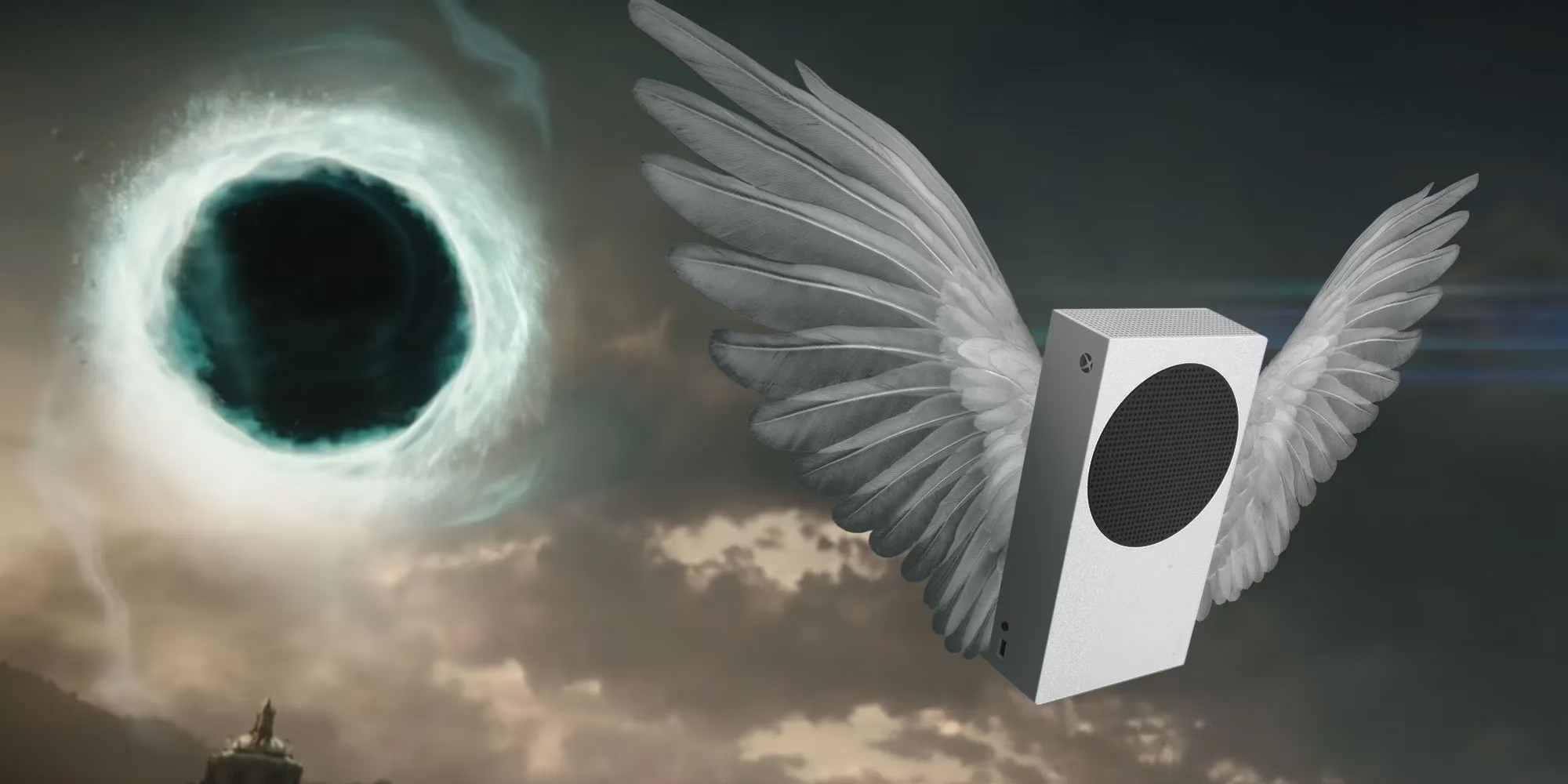
In the ever-evolving landscape of interactive storytelling, where technological ambition often collides with practical constraints, a quiet narrative unfolds—one not of limitation, but of creative adaptation. The journey of Baldur’s Gate 3 across diverse hardware platforms has become a testament to this philosophy. Far from viewing the Xbox Series S as an impediment, Larian Studios' creative lead, Swen Vincke, perceives it as a distinct canvas with its own set of parameters, a challenge to be met with thoughtful development effort rather than disdain. The platform, he asserts, is perfectly fine; it simply defines the boundaries within which a grand vision must be elegantly contained. This perspective reframes the conversation from one of holding back progress to one of mastering the art of optimization, a dance between infinite ambition and finite resources where every step must be deliberate and every flourish intentional.
A Symphony of Systems: The Developer's Canvas
For Larian Studios, the development process is not a monolithic task but a symphony orchestrated across varying instruments. Vincke draws a poignant parallel between developing for the Xbox Series S and two other distinct realms: the sprawling, heterogeneous world of minimum-specification PCs and the uniquely constrained environment of the Nintendo Switch. Each presents its own melody of challenges.
-
The PC Landscape: A vast, uncharted ocean where no two ships are alike. Here, optimization is not about a single target but about casting the widest possible net. It involves crafting a suite of graphical options—a delicate spectrum of settings—that allows the game to sing on a machine with a top-tier graphics card just as beautifully as it hums on a trusted rig from years past. This is the art of scalability.
-
The Switch Paradigm: Historically the weakest of the contemporary console generation, yet a platform that Larian has already conquered with Divinity: Original Sin 2. That success was not born of compromise in vision, but of extended, dedicated effort—proof that great depth can be made to run on modest hardware with time and ingenuity.
The Xbox Series S, in Vincke's view, resides in this same creative lineage. It is not an outlier but another verse in the same song. The challenge is not insurmountable; it is a matter of focused development effort. However, as Vincke candidly notes, even a studio that has grown significantly does not possess infinite resources. This reality necessitates a strategic, phased approach to bringing their epic to every player.
The Delicate Timeline of Readiness
In an industry often pressured by synchronized global launches, Larian Studios has chosen a different, more patient path—one guided by the principle of "ready when it's ready." The studio's current focus, as of 2026, remains sharply on delivering polished experiences for PC and PlayStation 5. Yet, in the background, a dedicated team diligently works on the Xbox iteration, making steady, tangible progress. Vincke offers hope for a release within the year but resists a firm commitment, acknowledging the mercurial nature of optimization: one knows the starting point, but the finish line can be a moving target.
This staged rollout—PC first, then PS5, followed by Xbox and Steam Deck—is a conscious strategy. It is a rejection of the notion that a delay for one platform must mean a delay for all. Instead, it ensures that each version meets Larian's exacting standards upon arrival, saving the game from being held back across the board. The wait, though perhaps longer for some, is the price of integrity.
The Philosophy of Maximization, Not Minimization
A central concern among fans has been the potential for cutbacks or diluted experiences on less powerful hardware. Vincke directly addresses this, emphasizing Larian's core tenet: "We always try to make the most of whatever platform is there." This is not a promise of parity, but a pledge of potential. It is a commitment to explore the unique capabilities of each system and extract every ounce of performance and fidelity it can offer. This philosophy extends beyond the Xbox Series S to even more specialized hardware.
Take Valve's Steam Deck, for instance. Michael Douse, Larian's head of publishing, has described the experience of playing Baldur's Gate 3 on the handheld as "absolutely wild." The team actively worked post-launch to achieve verification for the platform, treating it not as an afterthought but as a worthy destination for their rich, complex world. This effort underscores a broader truth: for Larian, optimization is a continuous, platform-agnostic pursuit of excellence.
| Platform | Core Challenge | Larian's Approach |
|---|---|---|
| Xbox Series S | Fixed, lower-spec hardware defining development parameters. | Treat it as a creative constraint, dedicating focused effort to maximize its potential. |
| PC (Min-Spec) | Immense hardware variability. | Build extensive scalability through graphical options and settings. |
| Nintendo Switch | Severe hardware limitations for a complex game. | Apply extended development time and proven techniques (as with Divinity: Original Sin 2). |
| Steam Deck | Handheld form factor with unique performance profile. | Pursue post-launch verification and optimization as a dedicated goal. |
The Broader Implication: A Defense of Creative Constraints
The discourse surrounding the Xbox Series S often frames it as an anchor dragging behind the sleek ship of next-gen progress. Larian's experience with Baldur's Gate 3 offers a powerful counter-narrative. It suggests that such "limitations" can, in fact, serve as catalysts for ingenuity. They force developers to think differently, to optimize more cleverly, and to ensure their core gameplay and narrative are so robust that they can shine even when graphical bells and whistles are tuned down.
This is not about celebrating weaker hardware, but about respecting the craft of development. It is a reminder that the soul of a game like Baldur's Gate 3—its intricate systems, its branching narratives, its deep character interactions—is not solely dependent on teraflops. By mastering the art of optimization across this spectrum, Larian is not just porting a game; it is ensuring that a vast, shared fantasy is accessible. They are building bridges, not walls, between different camps of players, proving that a great story, well-told, can find a home anywhere with enough care and dedication. In the end, the platform does not define the experience; the relentless pursuit of quality within its bounds does.